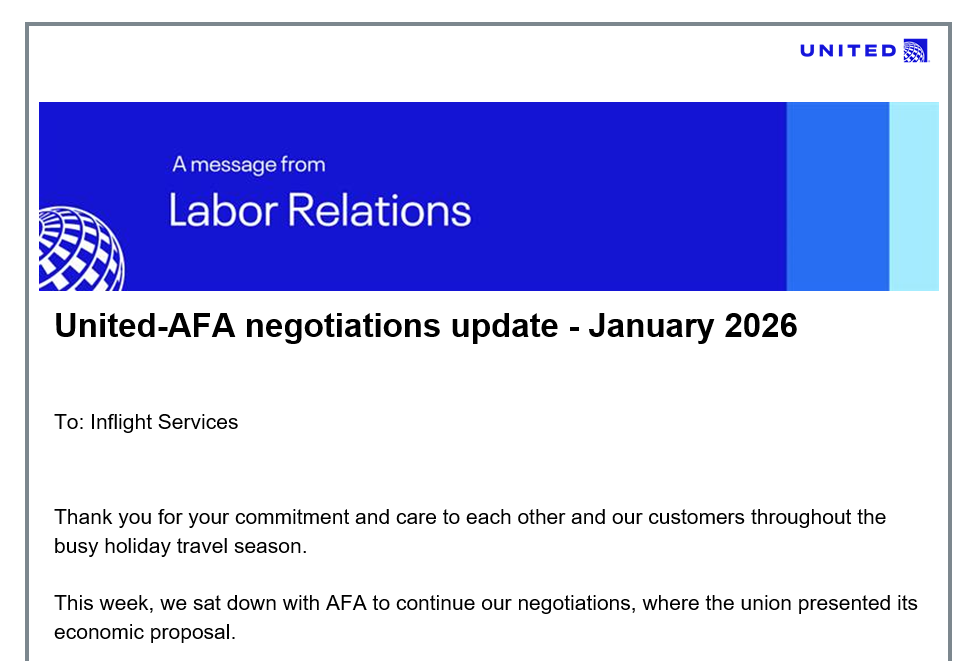
United just emailed every flight attendant to say: the union came back this week asking for more money, and the airline’s answer is fine — but cabin crew will have to pay for it in work rules.
In a blunt contract-negotiations update, the company dangles two things crews have been demanding for years, ground pay for long sits and shorter reserve availability periods, then pivots to the trade: offsets, including a controversial cut to reserve guarantees and a renewed push for preferential bidding system (PBS) scheduling.
It’s less a we’re close message than a map of what United wants next: raises and quality-of-life improvements only if the union accepts work-rule changes flight attendants have been resisting.
The union offered a new economic proposal this week. United says the proposal, “as currently presented,” would put them at a competitive disadvantage, and United delivered a counterproposal that they say hits “several of [the union’s] top issues,” explicitly calling out Sit RIG pay and Reserve Availability Periods (RAPs).
- It appears they’re offering to pay not just for boarding time in this contract but for time stuck on the ground between flight segments. A Sit RIG is a pay-protection formula that turns time into a minimum amount of credited pay, guaranteeing a certain amount of money for sit time.
Airlines can build pairings that look ‘legal’ but waste crew time. Sit RIG makes those pairings more expensive, pushing the carrir to build more efficient trips (or pay for the inefficiency). This was a union promise to members during negotiations, but that didn’t make it into the tentative agreement 71% of flight attendants rejected.
- United is also offering shorter ‘reserve availability periods’ making flight attendants less captive to the phone, a big quality-of-life improvement, but they’re hinting at looking to pay for this by changing reserve pay guarantees.
United says it also laid out ways to offset the cost of the union’s new asks. They’ll give, but they need give-backs to pay for it.
They’re suggesting that the original agreement which was rejected would have been “industry-leading pay among unionized U.S. carriers” and that they’re focused on getting raises “as soon as possible.”
It has been five years since they’ve had a raise, and inflation has eaten much of the value of their pay in that time! The union has suggested United should pay more now, even while they negotiate the contract, though that would take away the incentive for flight attendants to approve the non-pay portions of any agreement later.
Then they answer the two “most popular” questions they got from flight attendants:
- Why the company floated moving reserve guarantee from 78 to 75 hours and phasing out reserve override.
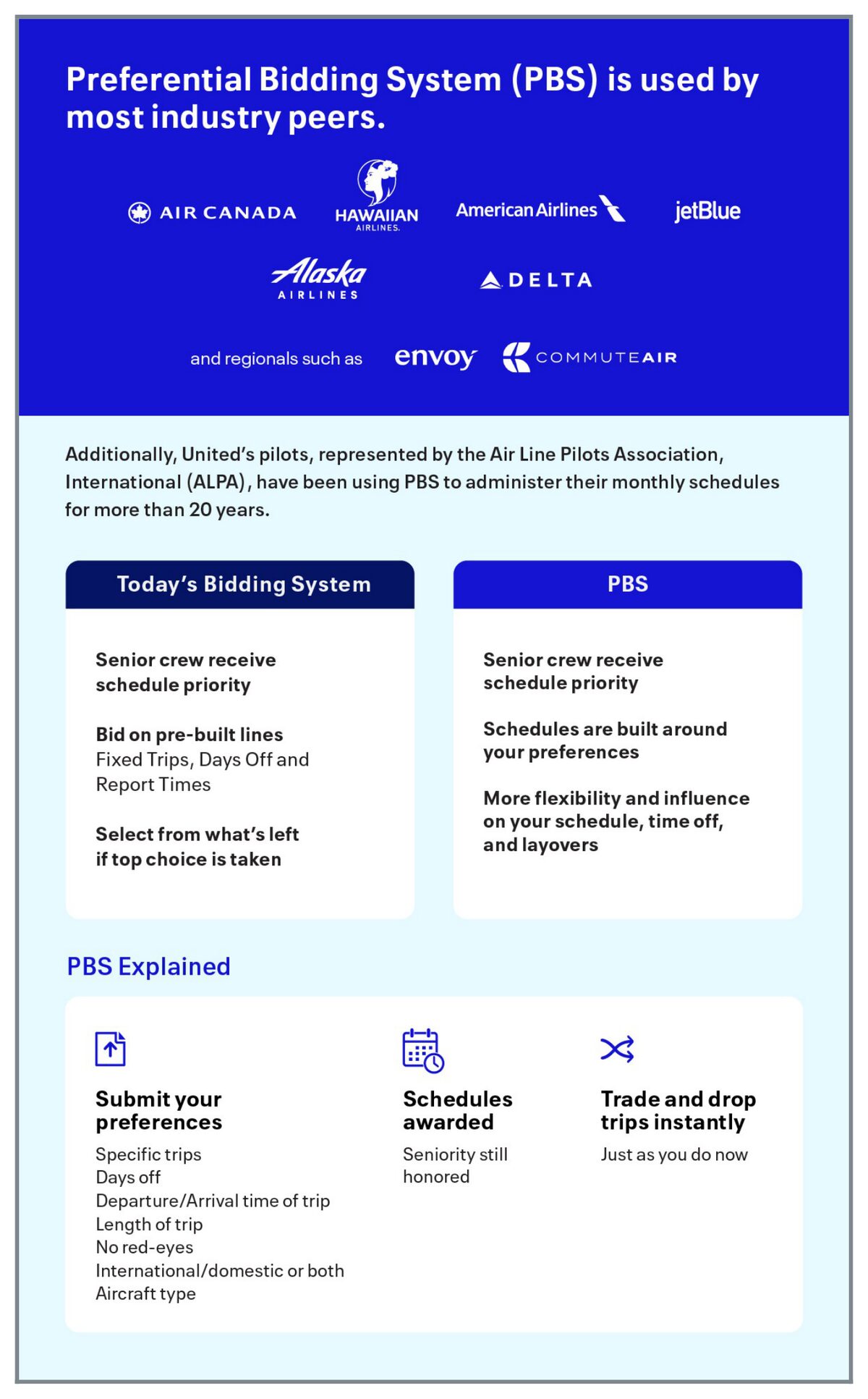
- What PBS schedule is.
They’re trying to reset the narrative after the 71% no. They’re telling crews they were already being offered something great in that first contract, the union is now asking for more, and it’s too expensive – but we’re still the adults in the room trying to get you paid quickly. That’s why they emphasize “you’ve waited too long” in their messaging while simultaneously saying AFA’s proposal isn’t “competitive.”
And they’re anchoring more money to we need offsets.” As I wrote at the outset when the contract was rejected, the union doesn’t get to just add higher pay and quality of life work rules. The contract is a bundle with a total cost. The union misread is membership and misallocated that cost in the earlier negotiation. Now they’re going to need to horse trade.
And United is highlighting exactly which trades are live:
- Ground pay and reserve availability changes are what they’re willing to talk about on the ‘give’ side.
- Reserve economics and structure and PBS scheduling is what they’re normalizing on the ‘offset’ side.
They’re confirm that rumored, controversial reduction in reserve guarantee from 78 to 75 hours is real, along with phasing out reserve override. This is being sold as the price of a popular win: AFA surveyed flight attendants who want shorter availability periods, and these “could be reduced to 12 hours” if the guarantee/override changes happen, which would “align” with American Airlines and their new contract.
Put another way, United is taking something that spooked reserves and packages it as the mechanism to get the thing people told their union they wanted.
United isn’t merely mentioning PBS, they’re trying to de-fang the objections by defining PBS narrowly.
- PBS awards schedules based on individual preferences rather than bidding pre-built lines.
- It doesn’t create pairings, doesn’t eliminate open time, and doesn’t change the ability to trade/drop.
- They explicitly say it’s “just the method for awarding monthly schedules,” while other rules remain negotiable.
Flight attendants hear “PBS” and think ‘algorithm assigned schedules’ (and a broader concern that PBS is a management efficiency project).
Clearly from this message there’s not a new tentative agreement imminent. The message reads as proposal exchange and positioning, not joint problem-solving at the finish line. The union presented economics. United says it’s too expensive and countered, and they’re trying to manage employee reaction. It’s designed to (1) box in AFA’s economics as unrealistic, (2) pre-sell offsets, and (3) soften internal resistance to the two likely targets—reserve structure changes and PBS.
Bargaining is expected to happen February 10-12 and then twice in March. They aren’t close, but they’re willing to give more – if flight attendants will accept things they don’t like.
More From View from the Wing
Link da fonte